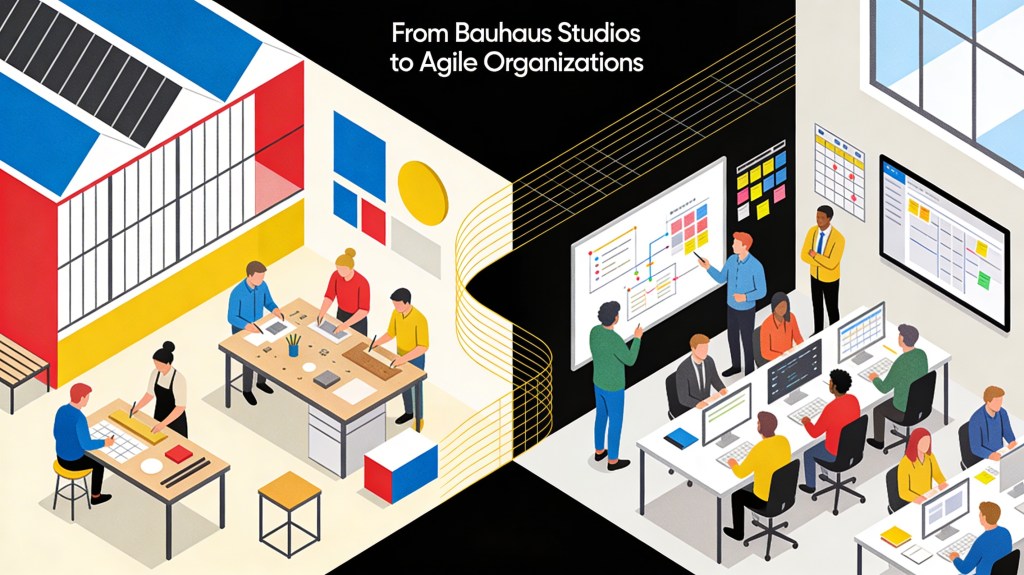
Revisiting the Manifesto through the AO Method
From Bauhaus to Organizational Design: Revisiting the Manifesto through the AO Method
The Bauhaus is widely recognized for its aesthetic legacy. It is also recognized for its experimental approach to pedagogy and collaboration. Additionally, it is known for integrating art, craft, and industry. This was highlighted by The Metropolitan Museum of Art in 2007 and My Modern Met in 2017. Walter Gropius’s “Bauhaus Manifesto and Program” of 1919 described a project. His project aimed to overcome the separation of the fine arts from everyday life. It proposed reuniting them around the “building” as a total work of art (Gropius, 1919/2020a, 1919/2020b). This article proposes key principles of the Bauhaus Manifesto. These principles can be productively extended to contemporary organizational design. This perspective aligns especially well with the Agile Organization (AO) Method (Neis, 2020, 2021, 2024; Neis & Gafner, 2024).
The Bauhaus Manifesto in context
Gropius published the Bauhaus Manifesto in 1919 in Weimar. This occurred after World War I. It was also following the collapse of the German Empire (The Metropolitan Museum of Art, 2007; Goldstein, 2019). The document presents the school as a solution to the perceived isolation of the visual arts. It argues that painting and sculpture had lost their architectonic function. They had devolved into “salon art” (Gropius, 1919/2020a, 1919/2020b). The Manifesto thus calls for a new institutional model. This model would train “architects, painters, and sculptors” as craftspeople. It would reunite them in a shared task: the creation of a unified architectural work (Gropius, 1919/2020a, 1919/2020b).
The often‑quoted opening statement, “The ultimate goal of all art is the building,” encapsulates this programmatic ambition (Gropius, 1919/2020a, 1919/2020b). Gropius does not see individual artworks as ends in themselves. Instead, he emphasizes their role as components of a more comprehensive, socially embedded structure (Gropius, 1919/2020b). Scholarship on the Bauhaus has emphasized that this move was both aesthetic and socio‑political. The school sought to reimagine the material world to reflect the unity of all the arts. It aimed to contribute to a broader cultural change. This change was part of the renewal process (The Metropolitan Museum of Art, 2007; Tysor, 2014; My Modern Met, 2017).
Workshops, curriculum, and the “new guild of craftsmen”
The figure of the workshop is central to the Manifesto. It also uses the metaphor of the medieval guild (Gropius, 1919/2020a, 1919/2020b; Getty Research Institute, 2019a). Gropius explicitly writes that “the school is the servant of the workshop.” This indicates that theoretical instruction should be subordinated to collaborative, hands-on production (Getty Research Institute, 2019a; Gropius, 1919/2020b). This principle was institutionalized in the Bauhaus curriculum. Students began with a preliminary course focused on materials, color, and basic formal relationships. Then, they entered specialized workshops. These workshops included areas such as metalworking. They also covered weaving, cabinetmaking, and typography (The Metropolitan Museum of Art, 2007; Getty Research Institute, 2019a, 2019b).
The guild metaphor underpins Gropius’s call to “create a new guild of craftsmen, free of the divisive class pretensions which endeavored to raise a prideful barrier between craftsmen and artists” (Gropius, 1919/2020a, p. x). Historians of the Bauhaus have noted that this move aimed to break down hierarchical distinctions between intellectual and manual labor, integrating design and production within the same learning environment (Bayer et al., 1938/2009; Tysor, 2014). In practice, workshop‑based education encouraged experimentation with materials and techniques. Students were expected to engage in socially oriented, practical design. This was emphasized rather than purely autonomous artistic expression (Getty Research Institute, 2019b; Tysor, 2014; My Modern Met, 2017).
By the early 1920s, however, the Bauhaus also had to respond to economic and industrial realities. In 1923, Gropius reframed the school’s aims under the slogan “Art and Technology – A New Unity.” He focused on designing prototypes. These prototypes were suitable for mass production (The Metropolitan Museum of Art, 2007; Goldstein, 2019; Tysor, 2014). The focus shifted from unique craft objects to simplified forms. These forms could be industrially manufactured. They combined functionality, aesthetic clarity, and affordability (The Metropolitan Museum of Art, 2007; Red Dot Design Award, 2025; Tysor, 2014).
Translating Bauhaus principles to organizational design
The Manifesto can be read as a theory of institutional design for an art school. Additionally, its core principles resonate with contemporary debates in organizational design and management. The AO Method emphasizes value streams, cross-functional collaboration, and iterative experimentation. It reflects a modern organizational concept. The concept closely aligns with the Bauhaus project (Neis, 2020, 2021, 2025; Neis & Gafner, 2024).
First, the Bauhaus demand that “all art” be oriented toward the building highlights an early articulation of outcome‑oriented work. It also suggests integrative work (Gropius, 1919/2020a, 1919/2020b). Transposed into organizational terms, the “building” becomes the organization’s value creation system. It includes the products, services, and societal contributions that constitute its raison d’être. The AO Method similarly advocates designing from value streams and customer outcomes. This approach is preferred over using departmental boundaries or legacy structures (Neis, 2020, 2024, 2025).
Second, the workshop model prefigures contemporary notions of cross‑functional teams and “studios” in organizational transformation. At the Bauhaus, workshops were sites where students applied theoretical principles to practical work. This practical work was often commissioned. It was often done in collaboration with industry (The Metropolitan Museum of Art, 2007; Getty Research Institute, 2019a, 2019b). In AO practice, organizational “studios” bring together participants from strategy, operations, technology, and enabling functions. They co-design and test new ways of working on actual value streams (Neis, 2020, 2024; Neis & Gafner, 2024). The underlying logic is analogous: learning occurs through situated, collaborative practice rather than detached planning.
Third, Gropius’s rejection of the hierarchy between the artist and the craftsman is significant. It parallels current efforts to reduce status barriers between “strategic” and “operational” roles. The Bauhaus insisted that it would educate both “competent craftsmen” and “independent creative artists.” The Manifesto also claimed that true unity comes from integrating multiple contributions. These contributions must be integrated coherently into a shared structure. This anticipates a more distributed understanding of authorship and responsibility (Gropius, 1919/2020b; Getty Research Institute, 2019a). AO methods apply this insight by pushing decision‑making closer to the teams that actually deliver value. They maintain architectural coherence at the system level (Neis, 2020, 2021, 2025).
Form, function, and systemic coherence
The Bauhaus is frequently associated with the modernist dictum “form follows function.” This principle, although originating earlier, was embraced in the school’s approach to design. It also influenced industrial collaboration (The Metropolitan Museum of Art, 2007; ArtSloth, 2024; Red Dot Design Award, 2025). Bauhaus products—such as Marcel Breuer’s tubular steel chairs or standardized typographic systems—aimed to combine functional efficiency with visual reduction. They also focused on structural clarity. Often, they emphasized fitness for purpose and “honest” construction (Red Dot Design Award, 2025; Ilustromania, 2025; Tysor, 2014).
From an organizational perspective, structural forms should be derived from an analysis of function and flow. These forms include team configurations, governance mechanisms, and roles. They should not stem from tradition or institutional fashion. The AO Method extends this logic by treating the organization itself as a designed system. Its architecture should reflect value flows, feedback loops, and learning cycles (Neis, 2020, 2022, 2025). In this sense, “form follows function” becomes a principle of organizational morphology. Structures are provisional and adaptable. They are contingent on the functions they are intended to support.
The Manifesto emphasizes systemic unity. The goal is for the ultimate aim to be a unified work of art. There should be no distinction between monumental and decorative art. This offers a productive analogy for thinking about coherence in complex organizations (Gropius, 1919/2020b). Bauhaus designers sought to integrate disparate elements into a coherent building. Similarly, organizational designers using AO tools seek alignment across strategy, structure, processes, and culture. They recognize that partial redesigns often fail when they remain disconnected from the whole system (Neis, 2020, 2025).
Conclusion: Toward an “organizational Bauhaus”?
Re‑reading the Bauhaus Manifesto through the AO Method highlights the continued relevance of early twentieth‑century design debates. These debates are still important for twenty‑first‑century organizational challenges. The Bauhaus model highlighted three critical elements for contemporary transformation efforts. First is the integrative purpose, referred to as the “building.” The second element is workshop‑based learning. The third involves breaking down strict hierarchies. This occurs between conception and execution (The Metropolitan Museum of Art, 2007; Getty Research Institute, 2019a; Tysor, 2014).
The AO Method can be understood as a contemporary “organizational Bauhaus.” It seeks to align diverse disciplines around value creation. It also embeds learning in practice. It considers organizational form a design variable rather than a fixed constraint (Neis, 2020, 2022, 2025). Practitioners can develop a more coherent approach to change. This is achieved by extending Bauhaus principles from objects and buildings to the design of organizations themselves. This approach acknowledges both the social ambitions of Gropius’s project. It acknowledges the complexity and adaptability of today’s enterprises. These characteristics have been discussed in various studies (The Metropolitan Museum of Art, 2007; Goldstein, 2019; Neis, 2025; Tysor, 2014).
Added AO references (APA 7th)
- Neis, P. (2020). The new normal: AO concepts and patterns of 21st‑century agile organizations. Agile Alliance.
- Neis, P. (2021). Swarming X4 [Book]. (Update publisher/location as appropriate.)
- Neis, P. (2022–present). Agile Organization (AO) model [Website]. Agile‑Organization.com. https://agile-organization.com/home/
- Neis, P., & Gafner, A. (2024, September 23). 12 steps towards Agile Organizations AO [Conference session]. Impact Hub Zürich.
- Neis, P. (2025, February 26). What does it mean to be an agile organization? LinkedIn Articles.
 Menschgeist
Leave a comment